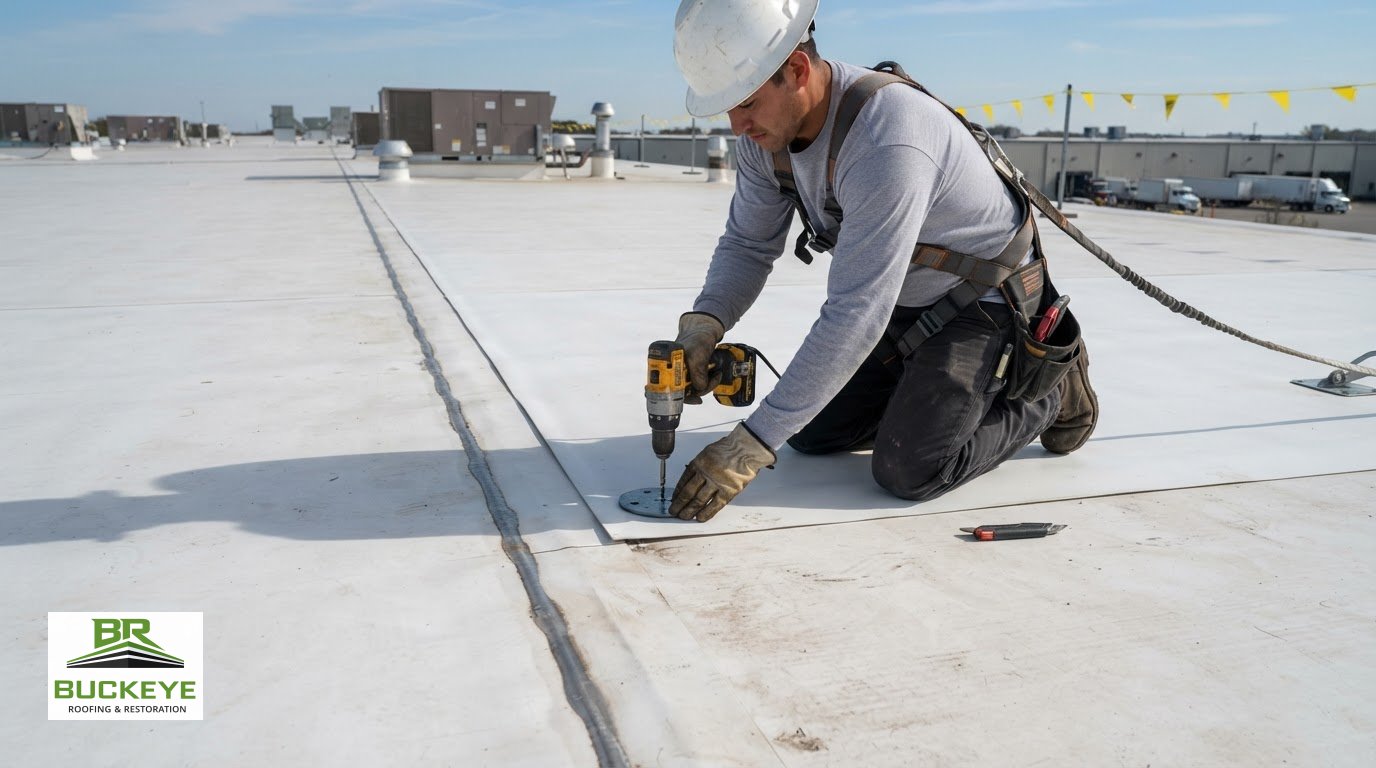
The manufacturer name alone won’t tell you whether a roof system fits your building. A GenFlex vs. Johns Manville commercial low-slope roofing comparison should also consider the membrane, attachment method, wind-uplift requirements, and the roof’s existing condition.
It’s reasonable to expect a clear answer when choosing between roofing systems, but there isn’t one brand that suits every commercial roof. This article explains how to compare TPO options, what affects wind uplift and fastening decisions, and how installation choices can shape future repairs. You’ll also see why the existing roof’s condition, drainage, and substrate matter when deciding whether repair or replacement makes sense. The aim is a practical comparison that helps building owners and facility managers focus on fit and performance, not just the name on the membrane.
Key Takeaways
- Compare roofing systems by how they fit the building, not by manufacturer name alone.
- Understand how roof construction and wind uplift needs inform attachment choices.
- See what installation details can affect future leak diagnosis and repair.
- Learn which existing-roof conditions matter when weighing repair against restoration or replacement.
- Find out how a professional assessment can help narrow down the right next step for a commercial roof.
Commercial roofing installation and repair
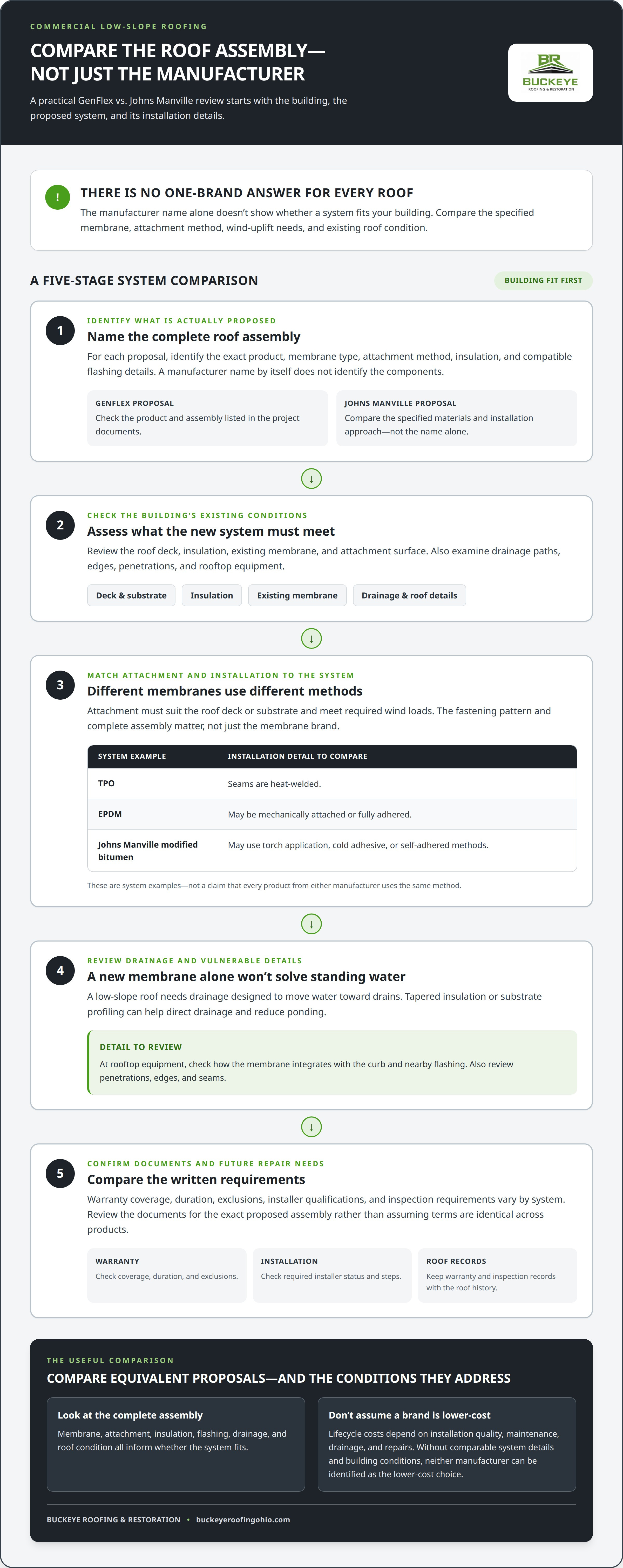
Start with the roof assembly, not the manufacturer label. TPO seams are heat-welded, while EPDM may be mechanically attached or fully adhered. These methods affect surface preparation, membrane attachment, and how transitions are handled. Johns Manville modified bitumen systems may use torch application, cold adhesive, or self-adhered methods. Each approach requires suitable substrate preparation and careful detailing around penetrations, edges, and seams.
Before installing a membrane, assess the existing roof, insulation, drainage, and attachment surface. A low-slope roof needs a drainage design that moves water toward drains; a new membrane alone won’t fix standing water. Tapered insulation or substrate profiling can help direct drainage and reduce ponding. Around a rooftop unit, for example, the membrane must integrate with the curb and nearby flashing to limit vulnerable gaps.
Wind-uplift requirements also shape installation. Attachment methods should suit the roof deck or other substrate and meet the required wind loads. The fastening pattern and complete assembly matter as much as the membrane brand. Changes in deck condition, insulation, or roof configuration can affect the installation plan, so assess these details before fastening or adhering the system.
Warranty coverage, duration, and exclusions vary by the specific GenFlex or Johns Manville system and its written warranty. A brand name alone doesn’t establish which repairs are covered or what conditions apply. Compare the warranty documents for the proposed assembly rather than assuming either manufacturer uses identical terms across its products.
Energy efficiency depends on the membrane and the complete roof assembly, not the manufacturer alone. TPO reflectivity can contribute to lower cooling loads, while insulation and roof configuration affect overall performance. Lifecycle costs also depend on installation quality, maintenance, drainage, and repairs over time. Without comparable system details and building conditions, neither manufacturer can be identified as the lower-cost choice.
Common repair issues include damaged membranes, failed seams, and leaks around penetrations or rooftop equipment. A TPO repair may involve preparing the surface and heat-welding compatible membrane over the damaged area. EPDM requires repair materials suited to that membrane. An inspection can help locate the leak, assess nearby details, and distinguish an isolated repair from broader deterioration.
Ratings from contractors and owners aren’t a consistent measure of GenFlex or Johns Manville roof performance. Results can vary with the system, installer, building conditions, and maintenance history. For a useful comparison, focus on the specified membrane, installation method, repair needs, and documented performance of the assembly rather than a general brand rating.
Installer qualifications and inspection requirements depend on the applicable warranty and system documents. Those documents specify any required installer status, installation steps, and inspections. Before work begins, identify the exact assembly and follow its documentation. After installation, keep the warranty and inspection records with the building’s roof history.
A practical installation and repair review should cover:
- The roof deck, insulation, and existing membrane condition.
- Drainage paths, penetrations, edges, and rooftop equipment.
- System-specific attachment, seam work, and repair materials.
- The written warranty and any associated inspection requirements.
Commercial roofing manufacturers
A manufacturer name identifies a product source, but it doesn’t show whether the roof assembly suits a particular building. Compare the proposed system, materials, installation requirements, and documentation. A GenFlex vs. Johns Manville commercial low-slope roofing comparison should begin with those details, not assumptions based on brand names.
GenFlex Low-Slope Systems
For GenFlex, start with the exact product and assembly proposed for the roof. Identify the membrane type, attachment method, insulation, and compatible flashing details in the project documents. This information shows what the system includes and lets you compare proposals on equivalent terms. The manufacturer name alone doesn’t identify the components or show how they fit the building.
Then compare the GenFlex proposal with the building’s actual conditions. A warehouse roof with rooftop equipment, for example, calls for a careful review of penetrations, drainage routes, and roof-deck condition. Check how the proposal addresses these details and which materials it specifies. This is more useful than judging the system by a general brand description, especially when competing proposals include different components.
Keep product documents with the building’s maintenance records. If a leak develops near a seam, curb, or roof edge, these records can help identify the installed materials. During a future inspection, they can also help a roofing professional distinguish the original assembly from later repairs or modifications. Clear records make comparisons between manufacturers more precise.
Johns Manville Low-Slope Systems
Johns Manville manufactures and markets commercial roofing and insulation, as well as glass fibers and nonwovens. Its TPO membranes for multifamily buildings can be mechanically attached, adhered, or self-adhered. Johns Manville modified bitumen systems may use torch application, cold adhesive, or self-adhered methods. These examples show why comparing the proposed system and installation approach is more useful than comparing manufacturer names alone.
Johns Manville traces its history to 1858, when the H.W. Johns Manufacturing Company began operating in New York City. That history provides company context, but it doesn’t establish whether a particular roof assembly is appropriate for a warehouse, manufacturing facility, or office. Compare the specified materials and assembly against the building’s existing roof, use, drainage, and project requirements.
For either manufacturer, identify the proposed membrane, insulation, attachment method, flashing details, and repair compatibility. Compare those components with the roof’s condition and intended use. A proposal for a multifamily roof, for example, may describe a different configuration from one designed for an industrial building. The GenFlex vs. Johns Manville commercial low-slope roofing decision is most useful when both proposals address equivalent project requirements.
Product documentation remains useful after installation. Keep assembly details, product identifiers, and repair records together. If a leak appears near a drain or penetration, these records can help an inspector identify which materials meet there. They also support targeted maintenance without assuming that every GenFlex or Johns Manville system uses the same components.
Wind uplift ratings and fastener requirements
Wind uplift is the force that can pull a roof assembly away from its supporting deck. For GenFlex and Johns Manville systems, attachment choices should suit the substrate and required wind loads. A mechanically attached membrane transfers force through fasteners and plates, while an adhered assembly relies on adhesive and the supporting layers beneath it. The manufacturer name alone doesn’t establish the assembly’s performance.
Wind, fire, puncture, and chemical-resistance ratings apply to specific membranes and tested roof assemblies. Compare the documented ratings for the exact GenFlex or Johns Manville system under consideration. Don’t assume that one TPO product’s rating applies to every membrane from that manufacturer. Near rooftop equipment or industrial exhaust, puncture or chemical resistance may matter alongside wind performance.
Fastener and adhesive requirements depend on the selected system. A mechanically attached assembly uses fasteners suited to the roof deck and specified fastening pattern. An adhered system requires compatible adhesive and prepared surfaces. Johns Manville TPO membranes for multifamily buildings can be mechanically attached, adhered, or self-adhered. These methods aren’t interchangeable: system documents specify the components and installation approach for each assembly.
Insulation, cover boards, plates, fasteners, adhesives, and flashing accessories must work together as specified. Changing one component can affect how the assembly is secured and performs. A proposal that names a membrane but leaves the insulation or attachment method unclear doesn’t describe a complete roof system. Compare both manufacturers’ full assembly details, including how the design handles roof edges, corners, penetrations, and transitions.
A brand name alone doesn’t establish whether a GenFlex or Johns Manville system is suitable for a project. Evaluate the exact assembly against applicable local building-code requirements and the building’s climate conditions. The review should consider the roof deck, attachment method, insulation, and documented system performance. For a facility exposed to strong winds, specified uplift performance and the fastening plan are central comparison points.
A practical review of the submittal should identify:
- The roof deck or substrate and the proposed attachment method.
- The exact membrane and assembly-level wind and fire documentation.
- Specified fasteners, adhesives, insulation, cover boards, and accessories.
- Documented puncture or chemical resistance relevant to the building’s use.
- How the proposed assembly addresses edges, corners, and roof penetrations.
These checks help distinguish a complete system proposal from a membrane-only description and give building owners a clear basis for comparing GenFlex and Johns Manville assemblies. If a proposal changes the substrate, insulation, attachment method, or accessories, review the full assembly again. A qualified project review should connect those details to the building’s wind loads, code requirements, and operating conditions.
Select insulation with appropriate R-values to meet ASHRAE or local energy-code requirements. When reviewing the full roof assembly, check the specified insulation alongside its attachment and documented performance.
Green roof assemblies need sufficient structural capacity for saturated growing media and plant loads. If a green roof is proposed, consider that capacity as part of the assembly review.
What commercial low-slope roofing systems does GenFlex offer?
GenFlex commercial low-slope options include TPO and EPDM membrane systems. These are distinct single-ply materials, so a proposal should clearly identify which membrane it includes. The choice affects the specified membrane, compatible accessories, and how the completed assembly fits the building. A GenFlex label alone doesn’t identify the proposed system.
TPO is a thermoplastic membrane with heat-welded seams. Careful workmanship is important at seams and roof details. For a building with several rooftop units, the proposal should explain how the system handles transitions and penetrations. TPO reflectivity can contribute to lower cooling loads, but the membrane alone doesn’t determine the roof’s overall energy performance.
EPDM is a synthetic rubber membrane. A GenFlex EPDM proposal should identify the assembly and compatible details for the specific project. A roof with multiple drains and curbs, for example, needs a clear scope showing how the membrane meets those features. The roof deck, insulation, drainage, building use, and existing roof condition all help determine whether an EPDM assembly fits.
For either GenFlex membrane type, distinguish new installation from work on an existing system. A new installation needs a defined assembly and details for transitions, edges, and penetrations. A repair requires identifying the installed membrane and damaged area before selecting compatible materials. If deterioration is widespread or moisture is trapped, an isolated patch may not address the underlying condition.
Use the written project scope to make the comparison concrete. It should identify the membrane type, proposed assembly, and how the work addresses roof features. If one proposal specifies GenFlex TPO and another GenFlex EPDM, compare each complete assembly with the building’s requirements rather than treating the names as interchangeable. Records of the selected system can also help with future inspections and repairs.
Before approving a GenFlex system, clarify:
- Whether the proposed membrane is TPO or EPDM.
- Which assembly components and accessories the scope includes.
- How drains, curbs, roof edges, and penetrations are addressed.
- Whether the work is installation, repair, or another type of roof project.
- How the system fits the existing roof, drainage, and building use.
This product-level review gives building owners a practical way to assess GenFlex options without assuming every project uses the same assembly. It also supports a fair comparison with another manufacturer: compare the specified membrane and complete system against the same building conditions and project needs.
A broader low-slope comparison may include built-up roofing, though it isn’t one of the GenFlex membrane systems discussed here. Built-up roofing can offer UV resistance through its bitumen and surfacing options. Consider this as one factor when comparing roofing approaches, while keeping the proposed GenFlex assembly clearly identified.
Built-up roofing is heavier than single-ply roofing, so designers should check that the building has adequate structural capacity. This is another reason to assess the complete proposed system against project requirements rather than comparing membrane names alone.
What commercial low-slope roofing systems does Johns Manville offer?
Johns Manville’s commercial roofing options include TPO membranes and modified bitumen systems. Start with the exact system named in the project scope, not just the manufacturer. TPO and modified bitumen use different materials and installation approaches, so they aren’t equivalent options.
Johns Manville TPO membranes for multifamily buildings can be mechanically attached, adhered, or self-adhered. These are different ways to secure a membrane within a roof assembly. The proposed method should suit the roof deck, project design, and documented system requirements. When comparing bids, check that each proposal identifies its attachment method and related assembly components.
A mechanically attached TPO proposal, for example, should identify its fastening approach, while an adhered proposal should specify the adhesive-based method. Self-adhered installation is a distinct option. These labels don’t describe every component or detail, so review the complete assembly information, including insulation and how the system meets drains, roof edges, curbs, and penetrations.
Johns Manville modified bitumen systems may use torch application, cold adhesive, or self-adhered methods. The selected approach depends on the system and job conditions, and affects how the work is carried out. The project scope should state the method clearly. A proposal that says only “modified bitumen” leaves important installation details unresolved.
To compare TPO with modified bitumen, first identify the existing roof and the work being considered. A replacement project needs an assembly suited to the roof deck, drainage, and building use. A repair instead calls for diagnosing the existing system and selecting compatible repair materials. The membrane category alone can’t answer either question.
Johns Manville also markets insulation alongside commercial roofing, making it important to review the roof as an assembly rather than a membrane in isolation. Insulation, attachment, drainage, and transitions all affect the proposed system. For a facility with rooftop equipment, the scope should clearly explain how the selected assembly handles those details.
Use these questions to assess a Johns Manville proposal:
- Does it identify TPO or modified bitumen and the specific assembly?
- Does it state the installation method, such as mechanical attachment or cold adhesive?
- Does it show how insulation and roof details fit the proposed system?
- Does the system suit the existing roof, drainage, and building use?
These checks make comparisons with GenFlex more precise. They keep the focus on the documented system and project fit, rather than assuming that one manufacturer’s products match another’s component by component.
Buckeye Roofing & Restoration
Buckeye Roofing & Restoration helps commercial property owners connect a roofing comparison to the roof’s actual condition. An inspection can show whether a low-slope roof needs repair, restoration, or replacement, rather than assuming the manufacturer choice alone settles the decision.
For active leaks or localized damage, commercial flat-roof repair may address specific problem areas. If the roof’s condition supports it, restoration or protective coatings may be appropriate alternatives to replacement. The right recommendation depends on inspection findings, including the existing materials, drainage, and substrate.
For a practical assessment of your commercial roof, contact Buckeye Roofing & Restoration.
FAQs
Does choosing a manufacturer automatically determine the best roof system?
No. The right choice depends on the building and the specific system proposed, not the manufacturer name alone.
Can a roof leak be repaired without replacing the whole roof?
Sometimes. An inspection can determine whether the problem is isolated or reflects broader roof deterioration.
What should I do if I notice a leak or roof damage?
Arrange a professional roof assessment. Don’t access the roof or attempt repairs yourself, especially if access is unsafe.
How do GenFlex and Johns Manville compare on energy efficiency, reflectivity, and lifecycle costs?
TPO reflectivity can contribute to lower cooling loads, but energy efficiency also depends on insulation and the complete roof assembly. Lifecycle costs depend on installation quality, maintenance, drainage, and repairs; the material alone doesn’t establish which manufacturer is less costly.
Which adhesives, fasteners, insulation, and accessories are required for each manufacturer’s roofing systems?
Requirements depend on the selected system, substrate, and project documents. Mechanically attached systems need fasteners suited to the deck and specified pattern, while adhered systems need compatible adhesive and prepared surfaces. Johns Manville modified bitumen systems may use torch, cold adhesive, or self-adhered methods.

Article by
Harry Stanley III
Harry Stanley III is a construction marketing strategist and fractional CMO at H&A Marketing. He has helped construction companies grow through website strategy, SEO, paid advertising, branding, lead generation, CRM systems, and professional content. His past work includes helping Meraki Solar generate an additional $3.7 million in revenue in his first year and supporting American Builders as a fractional CMO. Today, Harry works directly with custom home builders and construction companies to build marketing systems designed to generate qualified leads and measurable growth.