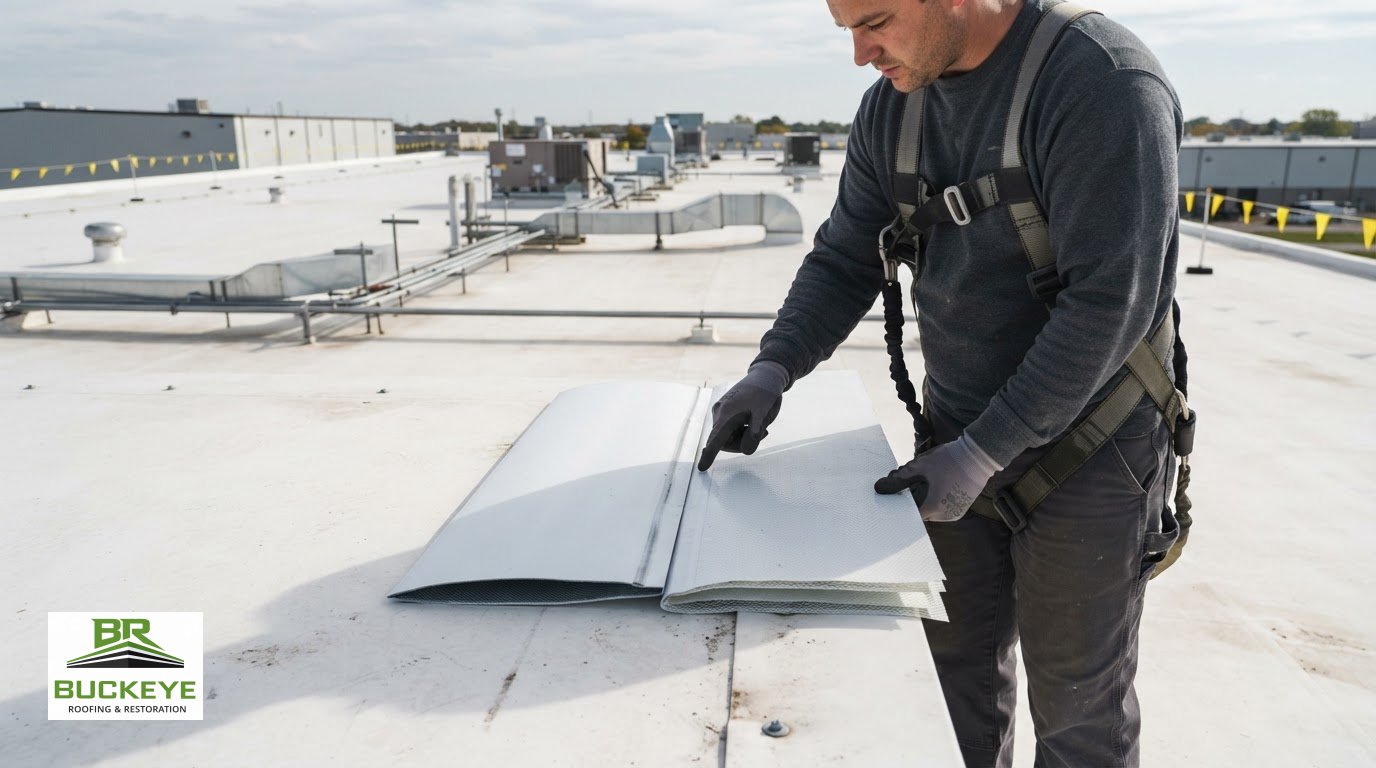
The lowest upfront bid is not always the lowest-cost roof over time. In a Sika Sarnafil PVC versus standard commercial TPO lifecycle cost comparison, PVC’s higher price may make sense when the building’s use and exposure favor its durability, but it is not automatically worth the premium.
It is reasonable to focus on installation cost: it is immediate, visible, and often easier to compare than future repairs or energy use. But the right choice also depends on roof details, maintenance needs, and how each system fits the building.
This comparison explains how installation price, energy performance, durability, and repairs affect total ownership cost. You’ll see when PVC may justify a higher initial investment, when standard TPO may be more practical, and what a commercial roof inspection can reveal before you decide.
Key Takeaways
- Compare the upfront premium with expected maintenance, repair needs, and how long the building is likely to use the roof.
- Account for roof use and exposure when weighing PVC’s durability against standard TPO.
- Review service-life and warranty terms separately; warranty coverage alone doesn’t determine a roof’s useful life or total cost.
- Include repairability and ongoing maintenance in the comparison, not just membrane and installation costs.
- Base the material choice on the roof’s condition, drainage, building use, and inspection findings rather than price alone.
Initial installation cost versus lifecycle cost
An upfront price comparison alone does not establish which membrane will have the lower lifecycle cost. Compare detailing, labor, future maintenance, and replacement scope for the building’s actual roof.
PVC and TPO Replacement and Disposal Costs
Tear-off and disposal costs depend largely on the existing assembly, roof access, and how much material must be removed. They do not automatically differ because the new membrane is PVC rather than TPO. For either thermoplastic system, proposals should account for existing layers, deck condition, insulation, and disposal requirements before comparing replacement scopes.
Ask for the same scope in each proposal: membrane installation, tear-off, disposal, and any substrate work should be clearly identified. That makes it easier to see whether a price difference comes from the PVC or TPO membrane, or from work included in only one proposal.
PVC and TPO Maintenance and Lifecycle Cost Factors
Lifecycle cost includes more than the initial installation. Climate exposure, roof use, drainage, maintenance, repair access, labor rates, and applicable building codes can all affect the project’s total cost. In the United States, climate also influences installation scheduling and the conditions a roof must handle, while local labor rates affect the installed work.
Building codes and the specified roof assembly can shape material and installation choices. TPO’s relative stiffness may make detailing around penetrations and complex areas more challenging, which can affect labor. Depending on the system and project design, PVC and TPO membranes may be mechanically attached, adhered, installed over hot asphalt, or attached using induction welding.
Installation quality matters for both systems. Crews need to fit sheets around roof edges, drains, curbs, and penetrations, then weld seams as the selected assembly requires. A complex roof with many transitions calls for more detailed work than a broad, unobstructed area. Evaluate TPO sheet handling and detailing at those transitions, not just across the open roof field.
Both membranes are thermoplastics, but their material characteristics and system specifications differ. The attachment method, insulation assembly, substrate, and roof geometry affect labor and detailing. A lower material cost alone does not establish a lower installed or lifecycle cost.
| Option | Upfront material | Installation considerations | Lifecycle comparison |
|---|---|---|---|
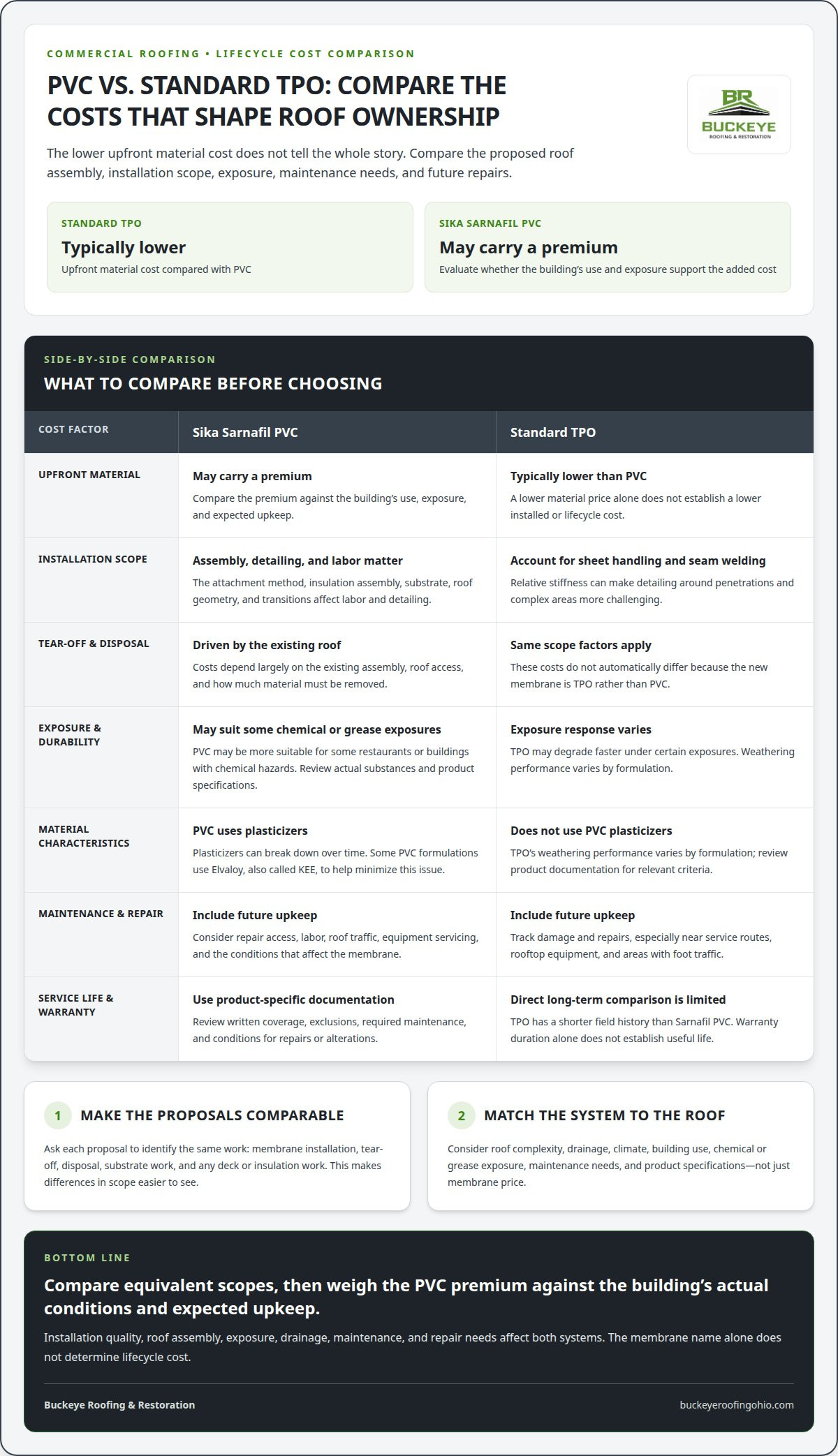
| Standard TPO | Typically lower than PVC | Detail stiffness and seam welding | Include repairs and future maintenance |
| Sika Sarnafil PVC | May carry a premium | Account for assembly, detailing, and labor | Compare expected use and upkeep |
Choose by comparing equivalent scopes against the building’s roof design, climate, use, and maintenance needs.
For a fair comparison, separate membrane and installation costs from tear-off, disposal, and deck or insulation work. Then consider how roof complexity affects labor, especially around penetrations and transitions. This helps clarify whether PVC’s higher initial cost fits the project or standard TPO better meets the building’s needs.
PVC roofing durability and service history
Durability depends on the membrane specification, installation, roof exposure, and maintenance. For a commercial property, assess these conditions alongside the roof’s use rather than treating the material name as a performance guarantee.
For chemical and grease exposure, PVC may be more suitable for some restaurants or buildings with chemical hazards. TPO may degrade faster under certain exposures, potentially increasing maintenance needs. The actual substances, exposure points, and system specifications matter. Puncture resistance also depends on the membrane and complete roof assembly, so compare product documentation rather than assuming one material always performs better.
PVC and TPO UV and Plasticizer Durability
PVC membranes use plasticizers to help maintain flexibility. These compounds can break down over time and affect membrane performance. Some PVC formulations use Elvaloy, also called KEE, to help minimize this issue. TPO does not use PVC plasticizers, but its weathering performance varies by formulation.
For either system, review the product’s technical documentation for stated exposure limits and performance criteria. Relate those specifications to roof conditions such as direct sun, rooftop equipment, and chemical exhaust. This is more useful than comparing broad claims detached from the building.
UV exposure is only one part of a roof’s working environment. Foot traffic during equipment servicing, abrasion near access routes, and contact with maintenance tools can affect the membrane. A facility with frequent rooftop work should account for those areas in its maintenance plan and keep records of damage and repairs.
PVC and TPO Service Life and Warranty Terms
Service-life estimates vary by product and roof conditions, so use product-specific documentation rather than treating a general range as a promise. The roof assembly, installation details, exposure, drainage, and maintenance all influence performance. TPO has a shorter field history than Sarnafil PVC, which limits direct long-term comparisons.
Warranty terms are separate from expected service life. Review the written coverage, exclusions, required maintenance, and conditions for repairs or alterations. A warranty’s duration alone does not establish a roof’s useful life or whether a particular repair is covered.
Start a practical review by identifying the building’s exposure: restaurant exhaust, chemical discharge, equipment locations, and regular service routes. Compare those areas with the membrane’s documented properties and proposed assembly. If the roof has visible wear or recurring leaks, an inspection can help establish whether damage is localized or widespread.
Documenting roof conditions supports better decisions later. Keep inspection findings, repair records, and notes about rooftop changes together. A new exhaust source or equipment service route, for example, can change a membrane’s exposure. These records help facility managers connect wear to roof use and plan maintenance without relying on assumptions about PVC or TPO alone.
Cost premium for PVC on a commercial roof
A PVC premium makes sense only when its added value fits the building’s needs. First compare equivalent scopes, then consider roof use, climate, maintenance, and future work. To assess the lifecycle cost of Sika Sarnafil PVC versus standard commercial TPO, look beyond membrane price.
Start with the written proposals. Match membrane type and thickness, insulation, attachment method, flashing, edge metal, tear-off, disposal, and deck work. If one proposal includes deck repairs and another excludes them, the totals do not represent the same project. Compare TPO and PVC after clarifying those scope differences.
Roof geometry can affect the premium. A large, open commercial roof has different detailing demands from one crowded with drains, curbs, equipment, and penetrations. Ask how the specified system handles those details. An adhered assembly uses adhesive to attach the membrane; other assemblies use mechanical attachment. The chosen method changes installation steps and may affect labor.
Building use matters, too. A food-service roof exposed to grease or an industrial roof with chemical exhaust may favor PVC’s resistance to certain exposures. Standard TPO may suit a roof with fewer chemical demands. Let the product specification and actual exposure guide the decision, not the material label alone.
Compare energy use separately. Membrane color and reflectivity are only part of roof performance; insulation, air leakage, rooftop equipment, and building operations also matter. Do not assume a PVC premium will be recovered through energy savings. Compare proposed assemblies and the building’s energy priorities before assigning value to that possibility.
Climate changes the practical calculation. A commercial roof in a region with snow, freeze-thaw conditions, and seasonal temperature swings needs reliable drainage and sound details around seams and penetrations. Those needs apply to both systems. Choosing a membrane cannot correct poor drainage or a weak roof assembly.
For a disciplined review, separate the decision into project costs and ownership considerations:
- Confirm that both proposals cover the same tear-off, insulation, and deck work.
- Compare membrane specifications, attachment, flashings, and treatment of roof details.
- Identify exposure to equipment, grease, chemicals, rooftop traffic, and climate.
- Consider expected maintenance and repair needs alongside the initial premium.
The premium is easier to assess when each factor connects to a building condition. A facility with chemical exposure may place more value on PVC’s resistance, while an uncomplicated roof may prioritize lower initial material cost. Neither example settles the choice without reviewing the assembly, drainage, and project scope.
If PVC addresses a real exposure or detailing concern, its premium may be worthwhile. If it does not, standard TPO may be the more proportionate choice.
Sarnafil PVC vs TPO: Service Life and Warranty Comparison
There is no single service-life figure that applies to every Sarnafil PVC or commercial TPO roof. Product choice, installation, exposure, drainage, and maintenance all shape performance. Treat lifespan estimates as planning references, then compare them with the specific membrane and assembly proposed for your building.
For a useful comparison, consider the building’s operating horizon. A facility expected to remain in service may have different roof-planning needs from a building scheduled for redevelopment. Each Sarnafil PVC and TPO proposal should identify the system components and conditions behind any stated service-life estimate.
Product-specific documentation matters more than a generic comparison. Review each proposal’s membrane specification, assembly requirements, and stated performance criteria. A roof with frequent equipment access, for example, may face different wear from an area with little rooftop activity. Those conditions affect how relevant a broad service-life estimate is to the property.
Keep warranty coverage distinct from expected roof life. A warranty describes the terms under which specified issues may be covered; it does not independently predict when a roof will need replacement. Compare the actual Sarnafil PVC and TPO warranty documents, including exclusions and requirements, rather than relying on a headline term.
Make warranty documents more useful by matching them to the proposed roof scope. Confirm that the specified membrane and assembly appear in the documents, and retain installation and maintenance records. If rooftop equipment is added later, record the alteration and its location so future service can be considered alongside the original system requirements.
For capital planning, compare each system’s documented terms with the property’s likely use and roof-management plan. A warehouse with ongoing operations may need a different maintenance approach from an office building undergoing planned renovation. Base the decision on those project conditions, not on an unsupported assumption that either PVC or TPO will reach a specific age.
When proposals make different service-life claims, ask what product documentation and project conditions support each estimate. A clear comparison helps owners assess the assumptions behind each option and plan maintenance around the building’s needs.
What are typical maintenance and repair costs for Sarnafil PVC versus TPO roofs?
Maintenance and repair costs depend on roof condition, exposure, access, and the type of damage. The membrane alone does not determine how much care a commercial roof will need.
TPO systems are estimated to reduce long-term maintenance burden by approximately 30-40% compared with PVC systems. Treat that as a broad comparison, not a project budget. Actual work depends on roof design, installation quality, membrane condition, drainage, and the building’s operations.
Repair needs often begin at vulnerable details. A leak near a drain, seam, curb, or rooftop unit may need targeted work, while widespread deterioration can call for a larger repair plan. TPO repairs and alterations may depend more on the existing membrane’s condition and system compatibility. PVC membranes can accommodate future repairs and alterations, but repairs still need to suit the roof assembly.
Building use can shift the comparison. PVC may be more cost-effective for roofs exposed to chemical hazards or restaurant grease, where TPO could degrade faster and need more maintenance. For a warehouse without those exposures, the chemical-resistance advantage may carry less weight. Rooftop traffic, equipment servicing, and drainage also affect repair needs.
Maintenance planning should focus on conditions that can be addressed before they spread. A qualified roof inspection can document seam condition, flashing details, drainage, penetrations, and signs of membrane damage. For facility managers, useful records include the inspection findings, repair locations, work performed, and any changes to rooftop equipment. These details help track recurring trouble spots and plan future maintenance.
Repair scope matters as much as repair frequency. A localized seam issue differs from moisture in the insulation or deterioration across a larger roof area. The first may call for a focused repair; broader damage may require evaluating restoration or replacement. An inspection identifies affected layers and whether the existing roof can support the proposed work.
For a practical lifecycle comparison, account for these items in your budget:
- Routine inspection and maintenance needs.
- Repair access around equipment, drains, and roof edges.
- Exposure to grease, chemicals, traffic, and weather.
- Compatibility of future repairs with the existing membrane system.
Do not compare PVC and TPO using a maintenance percentage alone. Consider the building’s use, current roof condition, and likely repair scenarios together. If leaks, visible damage, or recurring trouble spots need attention, Buckeye Roofing & Restoration offers free commercial roof inspections across Ohio, including Toledo, Findlay, Lima, Bowling Green, and Perrysburg.
Buckeye Roofing & Restoration
Buckeye Roofing & Restoration helps commercial property owners compare roofing options against the condition and needs of their buildings. An inspection can assess membrane condition, drainage, roof details, moisture, and structural integrity, helping determine whether repair, restoration, coatings, or replacement is appropriate. That assessment gives facility managers a practical basis for weighing PVC and TPO project proposals without treating the higher initial price as the only deciding factor.
If your commercial roof needs attention or you’re weighing system options, contact Buckeye Roofing & Restoration to discuss an inspection.
Turn the Comparison Into a Roof Plan
A roofing decision also affects capital planning, building operations, and future work schedules. Before choosing a membrane, consider how long the building will serve its current purpose and whether the roof plan fits that horizon. The lifecycle cost of Sika Sarnafil PVC versus standard commercial TPO is most useful when it informs a practical decision for the specific property, not a generic material preference.
Buckeye Roofing & Restoration provides commercial flat roofing, flat-roof repair, and roof restoration. An inspection can help determine the next step for the roof’s condition and the building’s needs, rather than treating replacement as the default answer.
Contact Buckeye Roofing & Restoration to discuss your commercial roof and plan a sensible next step. A clear assessment can help you move forward with confidence.
Frequently Asked Questions
What is the Difference between PVC and TPO Roof Membranes?
PVC and TPO are distinct thermoplastic roofing materials with different formulations and performance histories. PVC may suit roofs exposed to grease or certain chemicals, while TPO products vary by formulation and may fit other commercial applications. A facility with kitchen exhaust, for example, has different exposure concerns from an office roof. Compare the specific membrane, roof assembly, and building conditions rather than choosing by material name alone.
Are TPO and PVC the Same?
No. TPO and PVC are distinct single-ply membrane types, not interchangeable names for one material. Their formulations, chemical resistance, repair considerations, and product histories differ. Building owners reviewing an existing roof should identify the installed membrane before planning repairs or alterations. A patching method intended for one system, for example, may not suit another, so identifying the membrane helps guide compatible work.
How does the price vary between TPO and PVC membranes?
HomeGuide lists installed commercial roofing costs of $4 to $10 per square foot for TPO and $5 to $12 per square foot for PVC. Membrane thickness, insulation, attachment method, tear-off, roof access, and detailing can all affect a proposal. For a useful comparison, review bids with matching specifications and included work. A lower membrane price may not mean a lower project total if other scope items differ.
Is TPO Cheaper Than PVC?
TPO usually has a lower initial cost than PVC, but that does not settle the lifecycle comparison. Consider the roof’s exposure, expected maintenance, repair compatibility, and the building’s use. A warehouse with few chemical exposures may weigh the initial difference differently from a food-processing facility. Compare complete assemblies and project scopes, then assess whether PVC’s characteristics address a real building need.
How do PVC and TPO roofing compare in energy savings, reflectivity, and lifecycle operating costs?
Both systems can have reflective surfaces, but reflectivity alone does not determine a building’s energy use. Insulation, air leakage, climate, rooftop equipment, and operating schedules also influence performance. A reflective membrane, for example, cannot compensate for inadequate insulation. Compare complete roof assemblies and the building’s energy priorities; do not treat membrane color or reflectivity as a guaranteed savings figure.
What do independent studies or building-owner data show about PVC versus TPO roof performance and lifecycle cost?
Available comparisons don’t establish one universal lifecycle-cost winner for every building. A Structural Research, Inc. evaluation tested 45 rolls from major TPO brands, but that test does not by itself compare PVC with TPO over a building’s full ownership period. Building-specific records are more useful for budgeting: review repair history, maintenance, roof condition, and the system’s actual operating demands.

Article by
Harry Stanley III
Harry Stanley III is a construction marketing strategist and fractional CMO at H&A Marketing. He has helped construction companies grow through website strategy, SEO, paid advertising, branding, lead generation, CRM systems, and professional content. His past work includes helping Meraki Solar generate an additional $3.7 million in revenue in his first year and supporting American Builders as a fractional CMO. Today, Harry works directly with custom home builders and construction companies to build marketing systems designed to generate qualified leads and measurable growth.