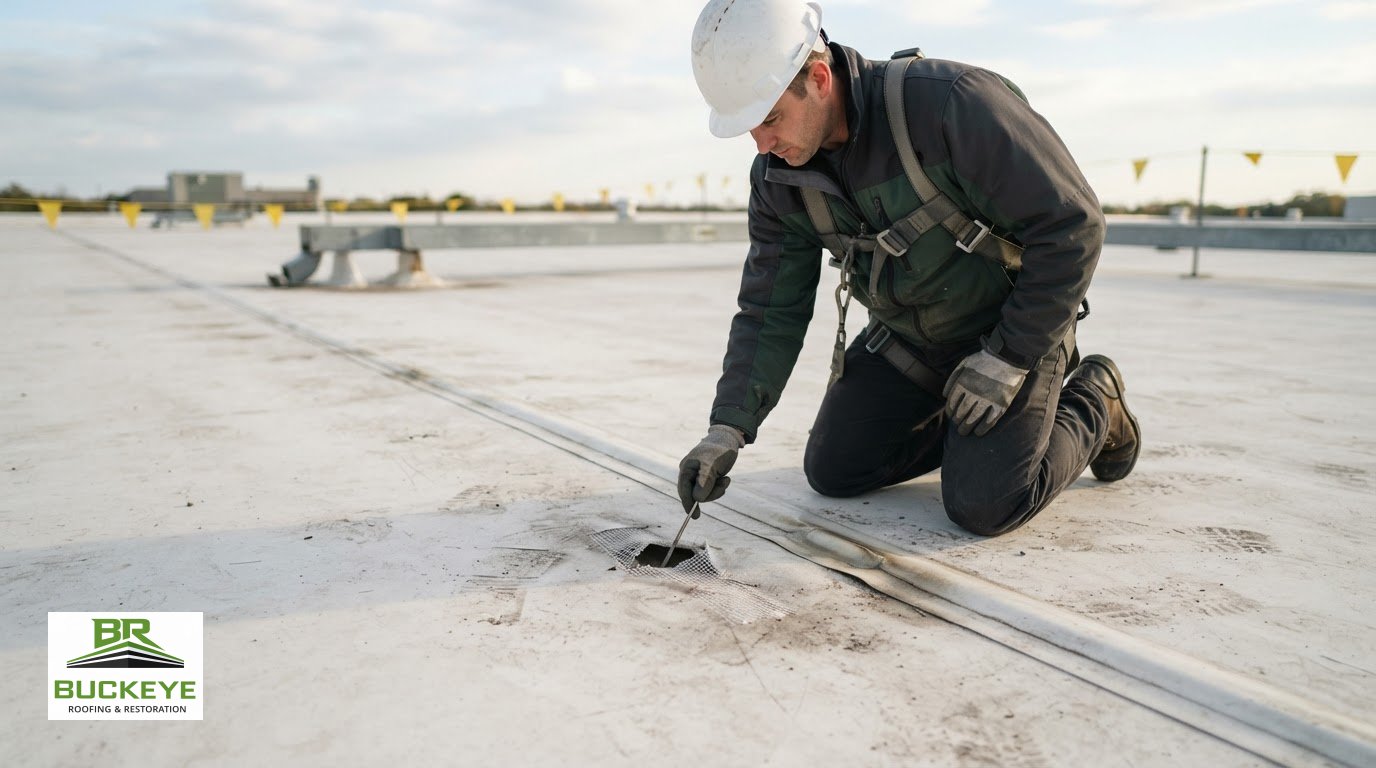
A single-ply roof can be durable without being tear-proof. Commercial single-ply tear resistance depends on the membrane material, its reinforcement, how it is attached, and the conditions it faces. TPO, EPDM, and PVC behave differently, so the material name alone doesn’t show how well a roof will withstand damage.
If you manage a warehouse, manufacturing facility, or other commercial building, you need a roof membrane suited to years of weather and routine building use. Durability depends on more than the sheet itself. This article explains how membrane type, installation, reinforcement, and exposure affect tear and puncture resistance. It also covers conditions that can weaken a membrane and when damage warrants a closer inspection.
Key Takeaways
- Identify whether a roof uses TPO, EPDM, or PVC, then consider how that membrane suits the building’s use and exposure.
- Compare attachment methods and reinforcement as part of the durability picture; the membrane alone doesn’t determine resistance to damage.
- Learn why tear-strength ratings need context and why a single number can’t describe how a roof will perform in service.
- Watch for signs such as punctures, tears, damaged seams, or recurring leaks, and arrange a professional inspection when they appear.
- Use the roof’s overall condition, drainage, and damage pattern to help guide whether repair, restoration, or coating is worth considering.
Does the type of membrane and installation method matter?
Yes. TPO, PVC, and EPDM differ in their material properties, while mechanical fastening, adhesive, and ballast affect how the roof assembly responds to forces.
Single-Ply Membrane Materials
TPO and PVC are thermoplastic membranes, while EPDM is a synthetic rubber membrane. Each forms a single-sheet roofing layer, but their properties suit different building conditions. TPO and PVC seams are hot-air welded; EPDM seams are adhered. These seam methods make installation quality and detailing part of the roof’s durability.
For a commercial roof, choose a membrane with the building’s use and exposure in mind. A reflective TPO or PVC surface may suit a roof where reflectivity matters. EPDM’s flexibility may be relevant where the membrane needs to accommodate movement. The material name alone doesn’t show how the complete roof will resist damage.
Membrane Advantages and Limitations
Single-ply membranes cover a low-slope roof with one primary membrane layer, which can simplify the assembly compared with multi-layer systems. Performance still depends on details such as seams, attachment, flashings, and the supporting roof’s condition. A membrane can withstand weather exposure yet remain vulnerable to a sharp object or a poorly finished edge.
Installation choices involve trade-offs. Mechanically fastened systems secure the membrane with fasteners, while fully adhered systems use adhesive. Ballasted systems use ballast to hold the membrane in place, adding weight and making them unsuitable for some buildings. Fully adhered systems cost more than other approaches and provide better wind-uplift resistance. The building structure, roof condition, and exposure should guide the choice.
These distinctions matter during installation and affect how the roof assembly handles wind and physical stress. Contractors need to assess the entire assembly, not just the surface sheet. A membrane’s tear resistance cannot make up for unsuitable attachment or weak detailing at roof edges and penetrations.
Tear and Puncture Resistance
Tear resistance describes how a membrane withstands a tear spreading; puncture resistance describes its ability to resist penetration. These are different properties, so one value cannot stand in for the other. Thickness and reinforcement also matter. For example, a 90-mil EPDM membrane has twice the puncture resistance of the original 45-mil rubber.
Consider TPO and PVC puncture resistance alongside membrane thickness, reinforcement, and installation details. A thicker or reinforced sheet may perform differently from a thinner, unreinforced one. Seams matter too: hot-air welding joins TPO and PVC sheets, so preparation and workmanship affect the roof’s continuity.
TremPly KEE is a named membrane product, but its name alone doesn’t establish a tear or puncture rating. Compare its product-specific test values with the roof’s expected exposure and assembly requirements. For any membrane, evaluate the test property, thickness, reinforcement, and installation method together. This provides a more useful basis for choosing a system than comparing material names alone.
What is single-ply roofing?
Single-ply roofing is a low-slope roofing approach built around a membrane layer. Its performance depends on how that layer suits the building’s structure and operating conditions.
Single-Ply and Modified Bitumen
The main difference is how each system provides waterproofing: single-ply roofing relies on its membrane, while modified bitumen uses multiple layers. This affects how a building owner evaluates roof details, maintenance access, and the existing assembly’s condition.
For example, a warehouse with rooftop equipment may need planned service paths to limit damage during maintenance. Modified bitumen and single-ply roofs may handle routine access differently, so building use matters as much as roofing material. Consider the existing roof, drainage, climate, and the work performed inside the building when selecting a system.
TPO and PVC are both thermoplastic options, but the material should suit the site’s actual demands. Chemical exposure from factory processes or kitchen exhaust can affect the comparison. Reflectivity may also matter when evaluating roof performance in a particular climate. Neither factor alone determines the right system.
Standards and Testing
Roofing standards and product tests explain how materials or assemblies are evaluated. Their practical value comes from matching the test information to the roof design, rather than treating a product result as proof of performance in every condition.
When reviewing specifications, identify which part of the roofing system was tested and what property the result describes. A membrane test doesn’t automatically describe the complete roof assembly, including its insulation, attachment, and supporting structure. This distinction helps building teams decide whether the documentation suits the intended application.
Deck and insulation compatibility also shape reroofing decisions. Insulation and cover-board choices should be checked against the roofing membrane and project requirements. These choices affect the assembly design and must suit the roof deck and project conditions.
An overlay may be possible when the existing roof and supporting structure are suitable. Before choosing this approach, an inspection should establish whether the deck can support the planned assembly and the existing roof can accommodate it. This evaluation helps distinguish a viable overlay from a project that needs more extensive preparation.
Single-ply roof durability and guarantees
A single-ply roof’s useful life depends on installation, exposure, drainage, and maintenance, not just membrane type. Warranty language describes specific coverage, while lifespan describes how long a roof may perform in service.
How durability and warranties differ
Typical single-ply roof guarantees range from 20 to 35 years when installation and maintenance follow manufacturer requirements. A manufacturer’s membrane warranty covers product defects; a contractor’s workmanship warranty covers installation quality. A full-system commercial roofing warranty often covers product and labor for 20 years or more.
These terms aren’t interchangeable. A warranty has defined coverage and conditions, while a lifespan estimate describes expected service with suitable care. For example, a membrane may remain in service even when its seams or flashing need repair. Review what the document covers, which components it includes, and what maintenance it requires.
Lifespan, inspection, and maintenance
Single-ply commercial roofing systems can last 20 to 30 years or more with proper care and maintenance. The research estimates TPO system life at 10 to 25 years, EPDM roofing life at 10 to 25 years, and PVC roofing at up to 30 years or more. These figures are not a promise for a specific building.
Maintenance should address conditions that could compromise the membrane. An inspection can identify punctures or tears, damaged seams, and flashing concerns. Debris removal and clear drainage matter too. A blocked drain on a low-slope roof can leave standing water, while a small puncture can expose the underlying insulation. Don’t walk onto the roof to investigate damage; professional access is safer.
Roof size, existing condition, and insulation
Roof size affects project planning because larger areas require more membrane, insulation, and installation work. The existing roof’s condition matters too: wet insulation, damaged areas, or a compromised deck can change the scope. A sound roof may allow an overlay, but its structure must support the new assembly.
Insulation affects thermal performance and the roof’s overall assembly. Polyiso is the most common insulation type in commercial roofing. EPS and XPS require cover boards, while single-ply membranes can be applied to polyiso without one. The right specification depends on the deck, existing conditions, climate, and building use. Insulation and membrane choices work together; neither can correct a weak or wet substrate.
What shapes project cost?
Averages can obscure what drives a commercial roof project. Roof area, access, removal of existing materials, insulation condition, deck repairs, drainage, and membrane selection all influence the work required. Replacing wet insulation, for example, involves different work from installing over a sound assembly. A roof assessment identifies these conditions before repair or replacement is recommended.
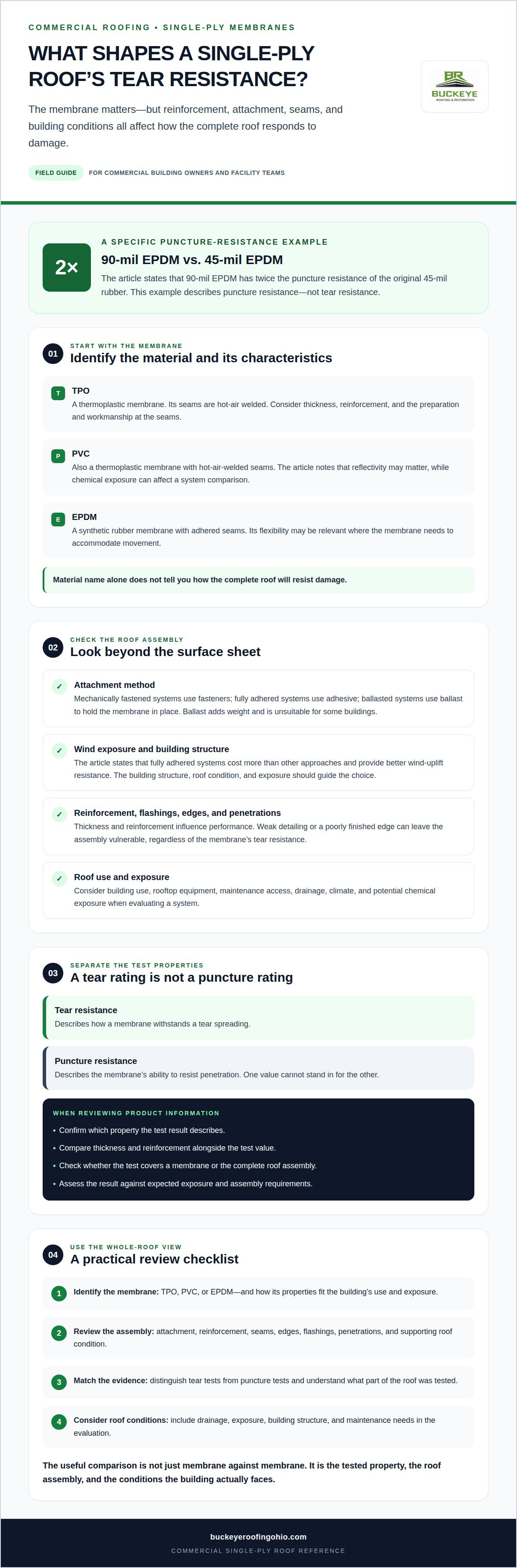
Resistance to tears, punctures, chemicals, weather, and UV rays
No single-ply material has a universal highest tear-resistance ranking. Compare the tested tear strength of the specific membrane, including its thickness and reinforcement, because product construction affects the results.
Tear and puncture resistance describe different types of failure. A tear can spread from a cut or stressed edge; a puncture occurs when an object pushes through the membrane. A dropped maintenance tool, for example, can cause a puncture, while a lifted edge may tear under stress. One property cannot substitute for the other.
Weather exposure adds another factor to the comparison. EPDM is described as having excellent resistance to weather and hail, while TPO is identified as resistant to ultraviolet exposure, algae, and chemicals. These general material characteristics don’t establish how a specific roof will perform. Thickness, reinforcement, seams, attachment, drainage, and the existing roof’s condition all affect the assembly.
Chemical exposure can make material choice especially important for industrial buildings. PVC is identified as suitable for settings such as restaurants, laboratories, and factories with grease or exhaust exposure because of its chemical resistance. TPO also has chemical resistance, but the substances and exposure conditions matter. A roof near kitchen exhaust, for example, faces different demands from a warehouse without process exhaust.
Membrane flexibility also affects how a material responds to movement and temperature changes. EPDM is known for its flexibility, while thermoplastic membranes such as TPO and PVC behave differently. Mechanically attached systems add another factor: fasteners and attachment details influence how forces transfer through the roof assembly. When assessing damage, a roofing contractor should distinguish membrane failure from a seam, flashing, or attachment issue.
Hail performance and accidental-puncture coverage are separate questions. A membrane’s resistance to hail doesn’t establish that a warranty covers hail damage or punctures. Coverage depends on the written terms, including covered components and exclusions. For example, a roof might have a product warranty while damage from a specific event falls under different terms.
When comparing membrane data, match the test result to the concern: tear strength for tearing, puncture resistance for penetration, and chemical compatibility for exposure. Then assess the full roof assembly, not just the sheet. If you notice a leak, visible tear, puncture, or storm impact, keep staff off an unsafe roof and arrange a professional inspection. The assessment should document the damage location and nearby seams, flashings, and drainage conditions.
No single-ply membrane type can be identified as having the highest tear resistance; comparable test results for specific products are needed to determine which performs better.
What are typical tear-strength ratings for TPO, PVC, and EPDM roofing membranes?
There isn’t one tear-strength rating that applies to every TPO, PVC, or EPDM membrane. Ratings depend on the specific product, thickness, reinforcement, and test method, so a useful comparison matches like with like. A product’s published value describes a tested sample, not every condition across an installed commercial roof.
Tear strength measures resistance to a tear spreading through material. It differs from puncture resistance, which measures resistance to a force penetrating the membrane. A TPO sheet might perform differently in these two tests, just as reinforced EPDM may differ from an unreinforced sheet. Check which property is being measured before comparing values.
For a fair comparison, gather product data for the exact TPO, PVC, or EPDM membrane under consideration. Then compare:
- Test property: Confirm that each value describes tear strength, rather than puncture resistance or tensile strength.
- Test method and units: Make sure the results use the same method and units before treating them as comparable.
- Membrane construction: Match thickness and reinforcement, since different constructions can produce different results.
- Test direction: Check whether the reported result applies across or along the sheet, when the product data provides that distinction.
For example, comparing reinforced PVC with a thinner, unreinforced TPO sheet doesn’t isolate the effect of material type. The difference could instead reflect thickness or reinforcement. The same caution applies to EPDM: a reported value for one formulation shouldn’t be treated as the rating for every EPDM membrane.
A higher tear-strength value can help assess resistance to tear propagation, but it doesn’t predict the durability of the entire roof by itself. Seams, flashings, attachment, roof traffic, and exposure also affect performance. A membrane may resist tearing yet remain vulnerable to punctures from sharp debris or tools. Likewise, a strong sheet can’t fix a weak seam or damaged flashing.
Use product technical data to compare equivalent test results, then consider how the roof is built and used. For a warehouse with routine rooftop equipment access, puncture resistance and protection around service paths matter alongside tear strength. For a roof exposed to chemical exhaust, material compatibility matters too. Product data narrows the comparison; roof conditions determine its practical relevance.
If you can see a tear, puncture, or recurring leak from a safe location, a professional inspection can identify the membrane and assess nearby seams and flashings. Request a commercial roof inspection to evaluate the damage and discuss next steps.
No representative tear-strength ratings apply across all TPO, PVC, or EPDM membranes. Actual values vary by product construction and test method, so compare data for the specific products under consideration.
Buckeye Roofing & Restoration
Buckeye Roofing & Restoration helps commercial property owners assess membrane damage and identify practical next steps. A free roof inspection can identify tears, punctures, seam problems, and underlying conditions that affect durability. The findings help determine whether commercial flat-roof repair, restoration, or coatings suit the roof’s needs.
A visible membrane tear, for example, may call for a targeted repair, while widespread wear needs a broader assessment. Restoration or coatings depend on the roof’s condition, substrate, moisture levels, drainage, and structural integrity. An inspection helps match the damage to an appropriate option instead of assuming every problem calls for replacement.
If you have concerns about a commercial roof membrane, contact Buckeye Roofing & Restoration to discuss an inspection.
Make the next roof decision with clear evidence
During your next maintenance review, connect roof concerns with what’s happening inside the building. Record where leaks appear, which operations or areas they affect, and whether they return after repairs. This history can help a roofing professional trace recurring problems and assess whether the roof needs focused attention or a broader plan.
For commercial single-ply tear resistance, a product rating is only one part of the decision. The building’s actual condition and use should guide what happens next. An inspection can turn visible concerns into a practical plan without assuming the entire roof needs replacement.
Buckeye Roofing & Restoration works with commercial property owners on flat roofing, repairs, and restoration. If you’re ready to discuss a roof concern, contact Buckeye Roofing & Restoration. A clear assessment is a sensible place to start.
Frequently Asked Questions
How long do single-ply roofs last?
Service life varies with the roof’s condition, installation quality, exposure, and maintenance history. For planning, review installation records alongside leak reports, repair history, and inspection findings. A roof with recurring problems in the same areas may need a different plan from one with isolated damage. These records help facility managers schedule work and plan future roof decisions without relying on age alone.
What Are Single-Ply Systems?
Single-ply roofing systems are commercial roof assemblies built around a membrane. For planning, consider the whole assembly, including supporting components, roof edges, penetrations, and transitions. For instance, a roof with multiple rooftop units needs carefully coordinated details around each unit. Reviewing the complete assembly helps building teams avoid treating a sheet specification as the entire roof design.
What Makes Single Plies Popular?
Building teams may choose single-ply systems as a membrane-based option for low-slope commercial roofs. The choice can also simplify coordination when a project has defined access, drainage, and equipment requirements. A warehouse roof with rooftop units, for example, needs planned service access and coordinated details. Popularity alone isn’t a reason to select a system; the building’s use and project conditions should guide the decision.
What is tear resistance in commercial single-ply roofing membranes?
Tear resistance is a material performance characteristic that helps assess how a membrane responds to tearing forces. For a building owner, its value is comparative: it helps evaluate products under stated test conditions but doesn’t predict an installed roof’s condition by itself. Use it as one input when reviewing a specification, then consider the roof’s observed condition and the damage pattern found during inspection.
How is single-ply roof membrane tear resistance tested and reported (ASTM D751)?
Interpret an ASTM D751 result by reading the test report, not just a summary value. Confirm that the document identifies the tested product and construction, the procedure used, the reported units, and any stated test direction. Those details help establish what the result represents. Don’t treat a number detached from its test report as a complete description of a roof’s expected performance.
How do membrane thickness and reinforcement affect tear resistance?
Record thickness and reinforcement in the roof specification and submittal. During project closeout, building teams can match the installed membrane identification to the approved product documentation. This record helps future maintenance teams identify the material when assessing damage or planning compatible repairs, rather than relying on appearance or assumptions.
What are the minimum tear-strength requirements for commercial roofing membranes under ASTM and building codes?
Don’t use one tear-strength figure as a universal acceptance threshold for every membrane and roof assembly. Project documents should identify the specified membrane and applicable performance criteria. A product data sheet helps identify tested properties, but it doesn’t replace the project specification. Keeping these documents together gives facility managers a clear reference when reviewing submittals, maintenance records, or proposed roof work.
What factors cause tearing in single-ply commercial roofs, and how can it be prevented?
Roof access and uncoordinated maintenance can expose membranes to avoidable damage. Set clear access procedures for staff and service crews, communicate where rooftop work is planned, and record observed damage for professional assessment. Don’t send untrained staff onto the roof to investigate or make repairs. If you notice a leak or visible damage, document its location from a safe area and arrange an inspection.

Article by
Harry Stanley III
Harry Stanley III is a construction marketing strategist and fractional CMO at H&A Marketing. He has helped construction companies grow through website strategy, SEO, paid advertising, branding, lead generation, CRM systems, and professional content. His past work includes helping Meraki Solar generate an additional $3.7 million in revenue in his first year and supporting American Builders as a fractional CMO. Today, Harry works directly with custom home builders and construction companies to build marketing systems designed to generate qualified leads and measurable growth.